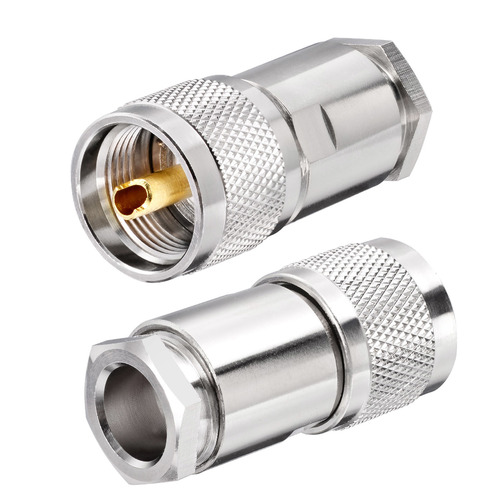
Product Description
Electrical:
Characteristic Impedance 50 ohm
Frequency Range DC-4 GHz
VSWR 1.15@DC-3 GHz
Dielectric Withstanding Voltage 1000V RMS,50Hz,at sea level
Dielectric Resistance 5000M
Contact Resistance Center Contact 1m
Outer Contact 0.25m
Enhanced Signal ReliabilityThe UHF F 2 Hole Solder Connector excels in maintaining a consistent and stable signal, vital for RF equipment and IBS-BTS systems. By using high-grade brass and precision engineering, the connector minimizes signal loss and interference, delivering reliable performance in critical communication infrastructure.
Ideal for Indian RF NetworksWhether implemented in new or existing RF cable assemblies, this connector caters to the diverse requirements of Indias RF professionals. Its broad compatibility, lightweight design, and easy installation make it a sensible choice for a variety of deployment scenarios across the nation.
FAQs of UHF F 2 HOLE SOLDER CONNECTOR:
Q: How is the UHF F 2 Hole Solder Connector installed in RF cable assemblies?
A: To install, the connector is soldered to the cable, ensuring a secure and stable connection. It uses two mounting holes for firm attachment, which helps sustain connectivity in RF network setups.
Q: What materials are used to manufacture the UHF F 2 Hole Solder Connector?
A: This connector is constructed using high-quality brass, offering robust durability, corrosion resistance, and optimal conductivity for high-frequency applications.
Q: When should I choose this connector for my RF system?
A: Select the UHF F 2 Hole Solder Connector when a reliable, high-power (up to 50 Watt) solution is needed for RF networks, cable assemblies, IBS, or BTS installations, especially in demanding environments.
Q: Where can I purchase the UHF F 2 Hole Solder Connector in India?
A: You can source this connector from authorized distributors, manufacturers, suppliers, traders, and wholesalers throughout India, ensuring widespread accessibility and support.
Q: What is the process for connecting this solder connector to an RF cable?
A: The core process involves stripping the RF cable, inserting it into the connector, and soldering the contact points. This ensures a high-integrity electrical link and secure mechanical fit.
Q: How does using this connector benefit RF equipment performance?
A: Employing this connector improves signal quality, reduces potential for electrical loss, and provides long-lasting reliabilityessential for maintaining uninterrupted RF operations.










 Send Inquiry


